
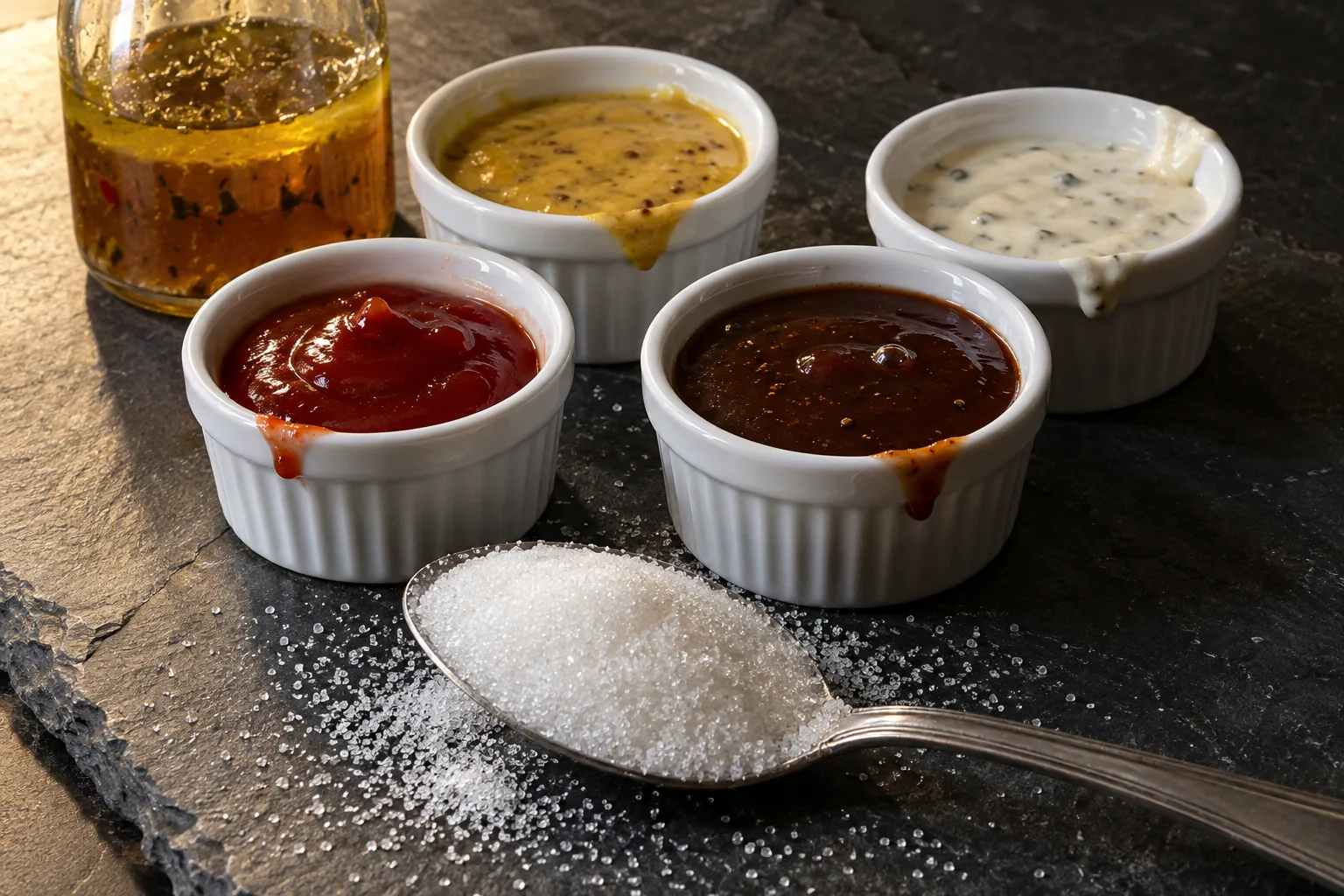
You planned the meal carefully, and the plate looked like a textbook example of blood sugar control. There was grilled chicken, a generous pile of steamed broccoli, and a garden salad from the crisper. Then came the barbecue sauce, a liberal pour of low-fat vinaigrette, and a puddle of ketchup. In about twenty seconds that dinner became something else entirely, and the culprit was Sugar in Condiments.
Sauces are the Trojan horses of the kitchen, because almost nobody counts them as food. We treat them as flavor, not as carbohydrate, and we assume that anything savory must be safe by definition. That assumption costs people real frustration, since manufacturers use sugar for texture, preservation and color first. This guide shows where the sugar hides, how to read a label, and which swaps are worth keeping.
Key Takeaways
- Sugar dissolved in a sauce reaches your bloodstream faster than the same amount inside a solid food.
- Ketchup, barbecue sauce and teriyaki are the three bottles most worth checking in your refrigerator door.
- Fat-free dressings usually replaced the missing oil with corn syrup or concentrated fruit juice.
- Label serving sizes describe a tablespoon, while most of us pour three or four of them without measuring.
- Mustard, hot sauce, vinegar and a well-stocked spice rack cover most of what a sauce was doing anyway.
Why Manufacturers Load Sugar in Condiments
Sugar in Condiments starts with production economics, since sugar is close to a miracle ingredient for manufacturers. It works as a preservative and keeps an opened bottle usable for months in the refrigerator door. Beyond that, it balances the acidity of tomato products and provides the glossy sheen on glazed meat.
The Bliss Point Behind Sugar in Condiments
The deeper reason, however, has a name in the food industry: the bliss point. This is the ratio of salt, sugar and fat that keeps you eating past the point of hunger. A bottle of ketchup is not simply tomatoes, because it is engineered to make the next bite feel necessary. I traced that engineering in Hidden Sugars in Food: How to Identify and Avoid Secret Sweeteners.
Why Liquid Sugar Moves So Quickly
There is a second problem, and it has to do with physics rather than marketing. Sugar suspended in liquid arrives without the fiber, fat or protein that would normally slow it down. As a result, a sauce behaves less like food and more like a sweetened drink poured over your dinner. The American Heart Association keeps a plain-language explanation of added sugars that is worth ten minutes of anyone’s evening.
The Worst Offenders: Where Sugar in Condiments Hides
Not every bottle deserves suspicion, since some are neutral and others are candy with a squeeze cap. These four account for most of the damage in a typical American refrigerator.
1. Ketchup: Sugar in Condiments at Its Most Familiar
Ketchup is roughly one third sugar by weight, which surprises almost everyone who hears it for the first time. A single tablespoon carries about four grams, or the equivalent of a level teaspoon of table sugar. The trouble is that nobody stops at one tablespoon, so a burger with fries absorbs three or four. That lands you around twelve to sixteen grams before the bun enters the conversation.
2. Barbecue Sauce: Molasses in Disguise
Barbecue sauce is the worst bottle in the door, since most brands list corn syrup or molasses first. A two-tablespoon serving can carry up to sixteen grams of sugar, and almost nobody brushes on merely two tablespoons. Heat caramelizes those sugars into something delicious, which is why the glaze keeps winning arguments.
3. Teriyaki and Hoisin: Sugar in Condiments With a Glaze
Asian-style glazes depend on sugar for that sticky finish, and hoisin is Chinese barbecue sauce for good reason. Teriyaki, at its simplest, is soy sauce plus sugar or mirin cooked down until it clings to the pan. This explains the mystery of the healthy stir-fry that somehow produces an unhealthy reading two hours later.
4. Honey Mustard
Plain mustard is one of the free lunches of diabetic cooking, with enormous flavor and no carbohydrate. Once honey joins the jar, though, the arithmetic changes completely and the ratio often sits near half and half. What was a zero-carb condiment becomes a dipping sauce with the glycemic profile of dessert.
The Salad Dressing Trap
The low-fat craze of the 1990s demonized dietary fat and left manufacturers with a flavor problem. They solved it with sugar and thickeners, and the bottles on the shelf today still carry that inheritance.
- French dressing frequently contains more sugar per serving than an equivalent pour of chocolate syrup.
- Raspberry vinaigrette gets its fruit character from concentrated juice or corn syrup rather than from raspberries.
- Thousand Island combines ketchup, sweet relish and mayonnaise, which stacks three sugar sources in one spoonful.
Olive oil dressings pair with Food Order and Blood Sugar: Why Eating Vegetables First Flattens Your Spike. Fat and acid also make a salad satisfying enough that you stop thinking about dessert afterward.
How Much Sugar in Condiments You Actually Use
The panel that lists Sugar in Condiments is honest, but its portion bears no relationship to reality. Measure one tablespoon of dressing onto a plate sometime, because that quantity persuades better than any article. The table below compares what the label promises with what usually reaches the plate.
| Condiment | Label serving | Sugar as listed | What usually lands on the plate |
|---|---|---|---|
| Ketchup | 1 tablespoon | about 4 grams | three to four tablespoons |
| Barbecue sauce | 2 tablespoons | up to 16 grams | a brushed glaze, several times over |
| Teriyaki | 1 tablespoon | soy sauce plus sugar or mirin | a pour across the whole stir-fry |
| Honey mustard | 1 tablespoon | often half honey by volume | a dipping pool beside the plate |
| Sriracha | 1 teaspoon | roughly 1 gram | a long squeeze over everything |
| Yellow mustard | 1 tablespoon | negligible | as much as the sandwich wants |
Reading the Label With Proper Skepticism
Two lines on the panel matter more than the rest, and they are Total Carbohydrate and Added Sugars. Ingredients appear in descending order by weight, which makes the first three the ones that matter. A bottle listing sugar, corn syrup, cane juice or dextrose there belongs back on the shelf. Manufacturers sometimes split the sweeteners into several varieties precisely so that none of them reaches the top of the list. The full method lives in Decoding Food Labels: How to Read Nutrition Facts for Diabetes Management.
Safer Alternatives to Sugar in Condiments
Managing diabetes does not require eating dry, joyless food, which is a myth that keeps far too many people miserable. Plenty of flavor boosters carry little or no glycemic weight at all.
Zero-Sugar Champions
- Yellow or Dijon mustard delivers a serious punch of flavor for a negligible carbohydrate count.
- Hot sauce is usually nothing more than vinegar and peppers, though sriracha is a notable exception.
- Vinegar in its apple cider, red wine and balsamic forms adds brightness, with aged balsamic used sparingly.
- Soy sauce or tamari brings umami depth, so watch the sodium rather than the sugar here.
- Real mayonnaise is eggs and oil, which makes it fat-dense but genuinely free of sugar.
I weighed the evidence on vinegar in Apple Cider Vinegar Blood Sugar: Separating Myths From Facts for Diabetics.
Homemade Swaps That Cut Sugar in Condiments
- A basic vinaigrette is three parts olive oil to one part vinegar, plus salt, pepper and dried herbs.
- A dry rub replaces barbecue sauce entirely with paprika, cumin, garlic powder, onion powder and chili powder.
- Fresh salsa needs only tomatoes, onion, cilantro, lime juice and as much jalapeño as you can handle.
For recipes that need sweetness, start with Sugar Alternatives for Diabetes: Comparing the Best Natural and Artificial Options.
Dipping Versus Drizzling
The physical gesture matters more than most people expect, because dipping and drizzling deliver wildly different quantities. A measured drizzle over the surface of your food stays within the amount you intended to eat. Dipping, meanwhile, coats every single bite generously and adds up long before the plate is empty. Worse still, dipping a breaded nugget into barbecue sauce joins a refined carbohydrate to liquid sugar. That double hit is what your meter will register two hours later. A protein-led plate blunts that effect, as Best Protein for Diabetics: Lean Choices to Manage Your Blood Sugar explains in more detail.
Dining Out: Sugar in Condiments You Cannot See
Restaurant kitchens use sugar for the same reasons, and you cannot see what happens behind the pass. A few habits restore most of the control you lose when someone else is cooking.
- Ask for sauces on the side, then dip your fork before spearing the lettuce rather than pouring the cup out.
- Ask direct questions about whether the house dressing is sweet or the glaze contains honey.
- Default to oil and vinegar, which every restaurant carries and which nobody has tampered with.
- Avoid the vocabulary of sugar on the menu, meaning glazed, sticky, honey, maple, teriyaki or barbecue.
Ordering is harder on difficult days, which Diabetes Burnout: How to Manage the Emotional Toll of Blood Sugar Care names honestly.
Sugar-Free Versions and What They Cost You
Most major brands now sell sugar-free ketchup and barbecue sauce, usually sweetened with sucralose or stevia. These cut the Sugar in Condiments sharply and let you keep flavors you grew up with. Some people find the aftertaste artificial, however, and sugar alcohols such as sorbitol can cause digestive complaints in quantity. On balance they are useful tools, provided you still read the rest of the ingredient list. The American Diabetes Association covers the broader eating pattern these swaps fit into on its healthy eating pages.
Frequently Asked Questions
Is balsamic vinegar high in sugar? It can be, since traditional balsamic from Modena concentrates as it ages. Cheaper commercial bottles often add caramel color and sugar to imitate that depth. Use it in moderation, ideally cut with olive oil.
Is sriracha safe for diabetics? Sriracha contains sugar, at roughly one gram per teaspoon, which adds up quickly. The chili garlic sauce sold in a jar with a green lid generally carries less.
What about coconut aminos? Coconut aminos come from coconut sap, at about one gram of carbohydrate per teaspoon. They beat teriyaki comfortably, but they are not a free pour.
Can I trust paleo ketchup? Paleo products avoid refined sugar and then reach for honey, maple syrup or dates instead. Those are still sugars, so the total carbohydrate line remains the number that matters.
Does spicy food lower blood sugar? Capsaicin shows some promise in insulin sensitivity studies, though the effect is modest. Stress management moves the needle further, as Diabetes and Stress: How to Break the Blood Sugar Spiral argues.
Flavor Without the Spike
Blood sugar control is usually won or lost in details small enough to feel unimportant at the time. You can master every macronutrient and still be undone by Sugar in Condiments at the end. Becoming a label detective takes a few weeks of deliberate attention, after which it becomes automatic and almost unconscious. Swap the sweetened sauces for spices, acid and heat, and the meals stay every bit as good. Flavor never required sugar in the first place, whatever the refrigerator door has been telling you.
Check out the author’s book here: Diabetic Air Fryer Cookbook.


Leave a Reply