
The scan is clear. The antibiotics are finished. Your doctor says the flare has resolved, and you should go back to eating normally. Yet for some people the gut stays touchy for weeks, and that is where a low FODMAP plan for diverticulitis can help.
So you do, and your gut disagrees. Bloating by mid-afternoon. Gas that embarrasses you. A dull ache that is not quite pain but never fully leaves. This is where a trial of low FODMAP for diverticulitis earns its place.
The stretch you are in has a name in the clinic: post-diverticulitis gut sensitivity. A low FODMAP approach is not for the flare itself, and it is not for life. It belongs here, in the awkward middle.
Key Takeaways
- A low FODMAP approach is for lingering bloating after a flare, not for treating a flare itself.
- FODMAPs are small carbohydrates that ferment in the colon and produce gas.
- Several high-fiber foods you were told to eat are also high in FODMAPs, which is the confusing part.
- The diet is a three-phase test, not a permanent way of eating.
- Fiber has to stay in the picture, because it is what keeps diverticula quiet long term.
Where Low FODMAP for Diverticulitis Fits
Timing decides whether this helps or hurts, so it is worth being blunt about the sequence.
During an acute flare, you are on whatever your doctor prescribed — usually clear liquids, then low fiber. FODMAPs are irrelevant at that stage. Our guide to diverticulitis diet plan covers that ladder.
Long term, the goal is the opposite: plenty of fiber, which is what the evidence supports for preventing the next episode. That is the subject of high-fiber foods for diverticulosis prevention.
In between sits a group of patients whose scans look fine and whose guts do not behave. Studies put post-flare irritable symptoms in a substantial minority of cases. For those people, fermentation is often the real problem, not inflammation, and a low FODMAP trial is the recognized way to test that.
The NIDDK guidance on eating with diverticular disease is clear that long-term fiber restriction is not the goal. Read this article inside that frame.
What FODMAPs Actually Are
The acronym is ugly and the idea underneath it is simple.
FODMAPs are short-chain carbohydrates that your small intestine absorbs poorly. They travel on to the colon largely intact. Bacteria there ferment them, and fermentation makes gas.
They also pull water into the bowel through osmosis. Gas plus water in a sensitive colon produces stretching, and stretching is what you feel as bloating and cramp.
The main families are worth recognizing on a label:
- Fructans — wheat, onion, garlic, rye.
- Galacto-oligosaccharides — beans, lentils, chickpeas.
- Lactose — milk, soft cheese, ice cream.
- Excess fructose — apple, pear, mango, honey, high-fructose syrup.
- Polyols — stone fruit, mushroom, cauliflower, and the sweeteners ending in -ol.
None of these damage a diverticulum. They simply produce volume, and a gut that is still touchy after an episode feels volume more than it used to.
The High-Fiber Contradiction
Here is what nobody explains, and it is the single most confusing thing about this diet.
Onion, garlic, beans, lentils, apples, and wheat bran are excellent fiber sources. They are also among the highest-FODMAP foods there are. So the advice to eat more fiber and the advice to reduce fermentation appear to point in opposite directions.
They only appear to. The resolution is that fiber is not one substance. Soluble fiber gels and moves gently; insoluble fiber adds bulk; fermentable fiber feeds bacteria and makes gas. Our guide to soluble versus insoluble fiber sets out which is which.
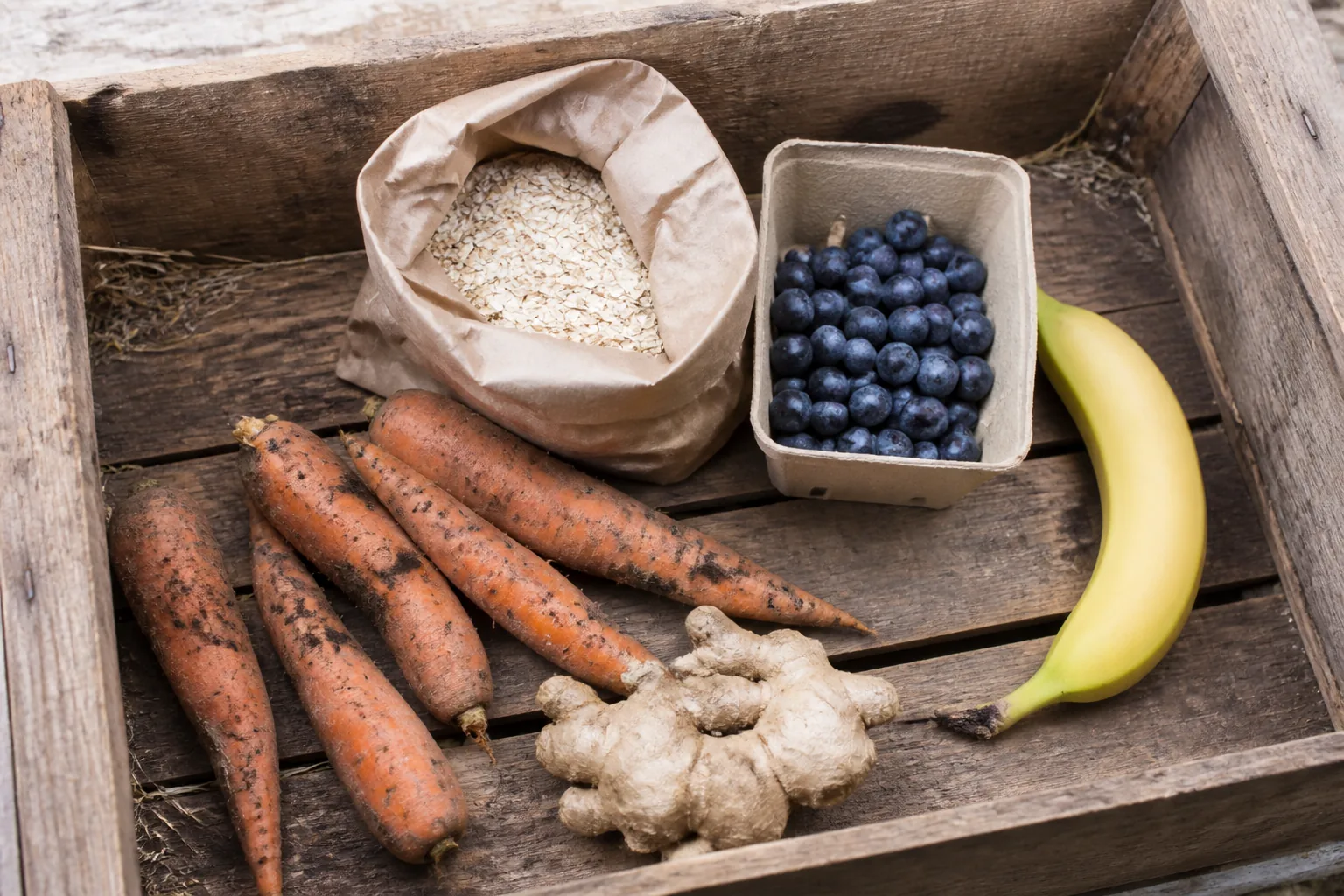
A low FODMAP plan aims at the fermentable end while keeping the rest. Oats, carrots, potatoes with the skin, berries, kiwi, chia, and firm bananas all carry real fiber and sit low on the FODMAP scale.
That is the whole trick. You are not cutting fiber. You are choosing the fiber that does not throw a party in your colon.
The Three Phases of a Low FODMAP Trial
This is a structured test with an end date. Treating it as a permanent diet is the mistake that causes harm.
- Elimination, two to six weeks. Remove the high-FODMAP foods together. If symptoms do not improve at all in six weeks, stop — FODMAPs are not your issue, and there is nothing to be gained by continuing.
- Reintroduction, six to eight weeks. Add back one family at a time, in a measured amount, over three days. Keep everything else stable so the result means something.
- Personalization, permanently. You end up avoiding one or two families in quantity and eating everything else freely. Most people find far less is a problem than they feared.
Phase two is the phase people skip, and skipping it is how a temporary test becomes a shrinking diet. Every family you never retest is a food group lost for no reason.
A short daily note is the only record-keeping needed: what you ate, what you felt, when. Our diverticulitis meal prep routine makes the elimination weeks manageable, because a planned week is far easier to interpret than an improvised one.
One caution before you begin. This diet is restrictive enough that a registered dietitian genuinely helps, and it is not appropriate for everyone — anyone with a history of disordered eating, and anyone already underweight, should raise it with their doctor first rather than starting alone.
Low FODMAP Swaps That Keep the Fiber
The practical core of the elimination phase, in one table.
| instead of | use | why it works |
|---|---|---|
| onion and garlic | garlic-infused oil, chives, green tops of leek | the flavor is oil-soluble, the FODMAPs are not |
| wheat bread | sourdough spelt, oat bread | long fermentation consumes the fructans |
| apple, pear | kiwi, orange, firm banana, blueberries | fiber without the excess fructose |
| beans, lentils | canned chickpeas, well rinsed, in small portions | rinsing removes much of what ferments |
| milk | lactose-free milk, hard aged cheese | the protein stays, the lactose does not |
| cauliflower, mushroom | carrot, zucchini, green beans, spinach | bulk without polyols |
The garlic-infused oil line is the one that changes cooking most. Fructans do not dissolve in fat, so the oil carries the flavor and leaves the trouble behind.
Portion matters as much as choice. Most FODMAPs are dose-dependent, so a quarter of an avocado behaves differently from a whole one, and a tablespoon of chickpeas is not a bowl of them.
What a Reintroduction Week Looks Like
Phase two is where the value is, and it is the phase people describe vaguely and therefore skip.
Here is the shape of one week, using lactose as the example.
- Day one: a small test portion, around half a cup of milk, with an otherwise low FODMAP day
around it. Note anything you feel, and when.
- Day two: a medium portion, around one cup, again with nothing else changed.
- Day three: a large portion, around one and a half cups.
- Days four and five: back to strict low FODMAP, whatever happened. This is the washout, and
it is what stops one family’s result contaminating the next.
- Day six: start the next family.
Three rules make the week mean something. Change one variable at a time, so no new food, no
new medication, no unusual exercise. Keep the base diet identical across the whole test.
Write it down the same day, because a reaction two days later is easy to attribute to the
wrong thing by Friday.
Six families take roughly six weeks at this pace. It is slow, and it is the only part of the
process that gives you a permanent answer rather than a temporary quiet.
A partial result is still a result. Many people find they tolerate a small portion of something
and not a large one, and that is the most useful finding of all: a threshold rather than a ban.
What Low FODMAP for Diverticulitis Will Not Do
Being honest about the limits keeps this useful.
It does not prevent diverticulitis. Nothing in the evidence suggests fermentation causes flares, and the long-term protection still comes from fiber, weight, movement, and not smoking.
It does not treat an active flare. If you have fever, worsening pain, or blood, that is a phone call, not a menu change.
It does not explain every symptom either. Stress alone changes gut motility, which is why stress relief for diverticulitis belongs in the same conversation. Coffee, alcohol, and very large meals act through their own routes entirely.
And it does not resolve the old myths. Nuts, seeds, and popcorn are not the villains they were once called, as diverticulitis and nuts explains, and low FODMAP has nothing to say about them either way. The Cleveland Clinic overview of diverticular disease says the same.
Cooking Through the Elimination Phase
Six weeks is long enough that the food has to be worth eating.
Build a base you trust. Rice, quinoa, potato, oats, and polenta are all safe ground, and they carry a sauce well.
Keep protein plain and moist. Chicken, fish, eggs, and firm tofu carry no FODMAPs at all. Season with herbs, lemon, and infused oil.
Make one soup a week. A carrot, ginger, and potato soup is gentle, high in soluble fiber, and freezes cleanly.
Watch the labels on anything processed. Onion and garlic powder hide in stock cubes, spice blends, and almost every ready-made sauce, and inulin has been added to a great many “high-fiber” products.
Drink water with the fiber. Fiber without fluid hardens rather than softens, which is why herbal options such as those in tea for diverticulitis earn their place.
Bacteria matter here too. Restricting fermentable carbohydrates for months does reduce the bacteria that live on them, which is one more argument for a short trial rather than an indefinite one — our guide to gut flora restoration covers rebuilding afterward.
Frequently Asked Questions
How soon will I know if it is working?
Most people who respond notice a difference within two weeks. Six weeks with no change at all is a clear answer, and the right response is to stop and look elsewhere.
Can I follow a low FODMAP diet permanently?
You should not. It narrows the diet, cuts fiber variety, and starves useful bacteria over time. The endpoint is a personalized list of two or three foods to watch, not a permanent list of hundreds to avoid.
Is this the same as identifying trigger foods?
Related but not identical. A trigger list is built from experience; a low FODMAP trial is built from a structured elimination and retest. Our article on diverticulitis flare-ups covers the informal version.
Do I have to give up coffee?
Coffee contains no FODMAPs. It does speed the gut and increase acid, so it may still bother you — but that is a separate test, and running two at once tells you nothing about either.
What if I react to everything I reintroduce?
That usually means the base diet was not stable, or the washout days were skipped, rather than
that every family is a problem. Start again more slowly with one family, and involve a dietitian
before you conclude that your list of safe foods is that short.
A Tool, Not a Life Sentence
The worst outcome here is not that a low FODMAP trial fails. It is that it half-works, and you stay in phase one for two years, eating a diet that shrinks every time something disagrees with you.
Run it properly. Six weeks in, eight weeks reintroducing, then back to a wide plate with two or three known limits.
A gut that stays touchy after a flare is common, and it usually settles. Your job in the meantime is to find out what it actually objects to — and to keep eating well while you find out.
Check out the author’s book here: Diverticulitis Cookbook.


Leave a Reply