
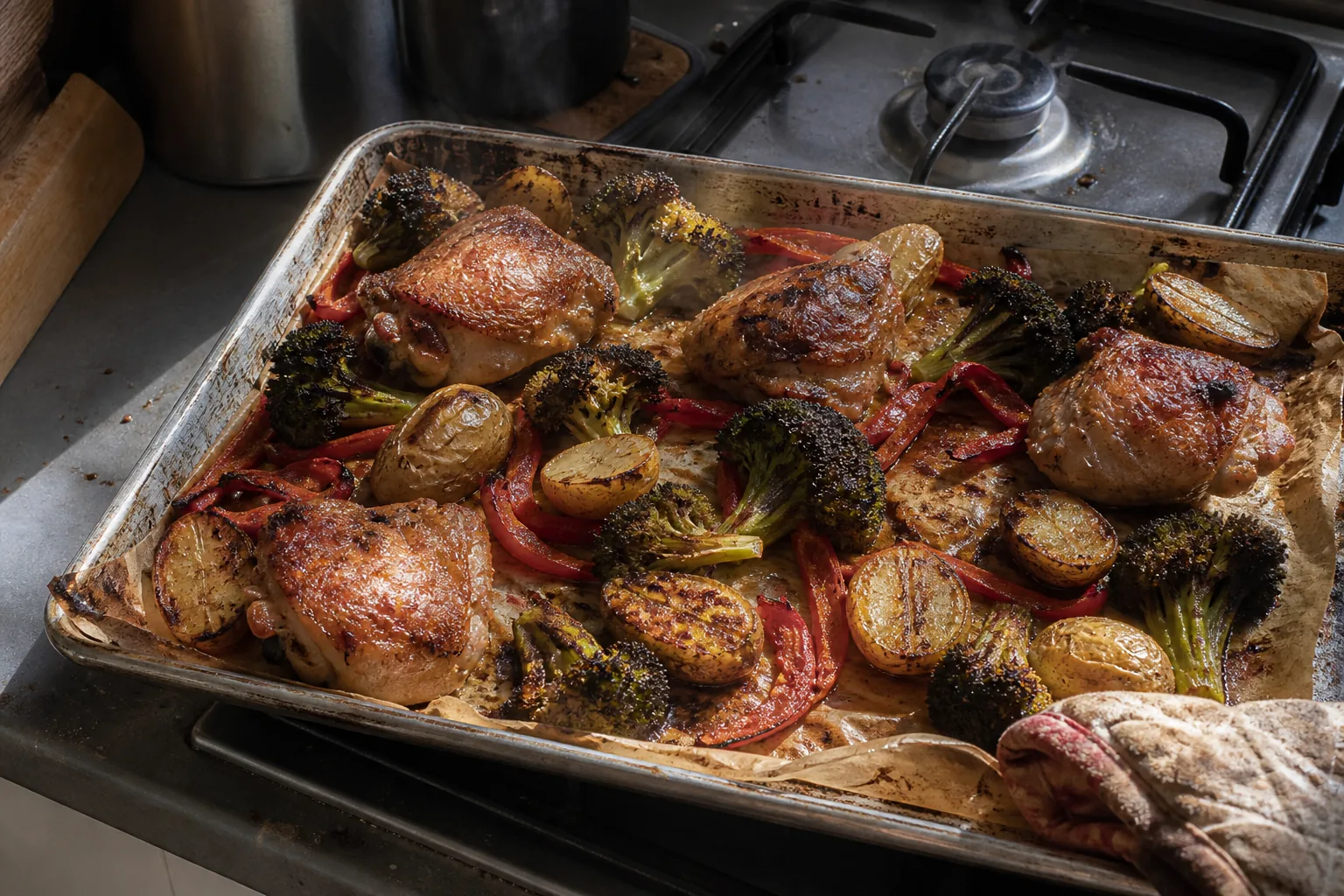
It is seven o’clock, you are tired, and the honest options are cereal or whatever sits in the freezer. That hour undoes more post-operative eating plans than any restaurant menu ever will, although it has very little to do with willpower. Sheet Pan Dinners solve it with almost embarrassing simplicity: one tray, one temperature, one wash-up, and four small portions from a single twenty-five minute cook.
The catch is that most tray recipes speak to people who still eat a full plate. A pouch needs the method adjusted, and the adjustment is mostly about moisture.
Key Takeaways
- Sheet Pan Dinners produce four post-operative portions from one cook and one pan.
- The formula never changes: a protein, a dense vegetable, a quick vegetable, and fat.
- Foods go on the tray in stages, because each one needs a different amount of heat.
- Roasting dries protein out, therefore the sauce goes on after cooking rather than before.
- Portioning straight off the hot tray is what stops the leftovers from quietly disappearing.
Why Sheet Pan Dinners Work After Surgery
Three things go wrong at dinner in the first years after surgery, and one tray addresses all three of them.
Effort. Cooking for a portion the size of a teacup feels absurd, so many patients skip the stove and graze instead. A tray removes the sense that the work sits wildly out of proportion to the meal.
Repetition. The same grilled chicken every night is how people end up hating protein entirely. Roasting changes the flavor of identical ingredients completely, which is one route through the problem our bariatric menu rotations guide sets out. For the same reason, the spice cupboards behind our bariatric international recipes can rescue a week that has gone flat.
Timing. Twenty-five minutes of oven time is twenty-five minutes you spend somewhere other than the stove. That appeal sits behind our 30-minute bariatric meals too, although a tray asks for even less attention.
There is a fourth benefit nobody mentions. A tray produces genuinely separate components, so you can eat the protein first and see how much you have had.
The Formula Behind All Sheet Pan Dinners
Every tray runs on the same five parts, so learn them and you will never need a recipe again.
- One protein, cut into even pieces so the whole tray cooks at one rate.
- One dense vegetable, such as potato, carrot, squash, or a thick cauliflower stem.
- One quick vegetable, such as pepper, zucchini, asparagus, or broccoli florets.
- Fat, meaning a tablespoon of oil brushed across the tray rather than poured over it.
- Acid and herbs at the end, because lemon, vinegar, parsley and dill fade under long heat.
The proportions matter for a small stomach. Fill half the tray with protein rather than the quarter a standard recipe suggests, since protein is what your portion has to deliver first. The vegetables are the part you will not finish anyway.
Choosing the protein deserves a moment. Chicken thigh, salmon and pork tenderloin roast far better than breast meat, which dries at exactly the point it becomes safe to eat. The American Heart Association guide to picking proteins is a reasonable starting point for leaner cuts, although after surgery the moister ones usually win.
Staging: The Step That Saves the Vegetables
Everything on one tray does not mean everything at once. That mistake produces raw potato beside burnt zucchini, and it is the single most common tray failure.
Set the oven to 425°F, then work in three entries:
- Minute zero: the dense vegetables, tossed in oil and spread with space between them.
- Minute twelve: the protein, plus the quick vegetables that only need a short blast of heat.
- Minute twenty-two: check, because most combinations finish between twenty-two and twenty-eight minutes.
Oven Temperature and Rack Position
Two rules make the difference between roasting and steaming. Give everything room, because crowded food releases water and then stews in it. Use the middle rack as well, since the bottom one burns the underside before the top has any color.
Parchment is worth its small cost, since it keeps the sugars off the pan and leaves nothing to scrub.
Three Sheet Pan Dinners to Start With
Each of these makes four post-operative portions, and all three follow the staging above.
Lemon Chicken Thigh With Broccoli and Potato
Six boneless thighs, a pound of small potatoes halved, and two cups of broccoli. Potatoes go in first, then thighs and broccoli at minute twelve, with lemon and parsley scattered at the end. This is the most reliable of the three, and it reheats better than either of the others.
Salmon With Asparagus and Cherry Tomatoes
Four fillets, a bunch of asparagus, and two cups of tomatoes. Give the tomatoes eight minutes alone, then add the salmon and asparagus for twelve more. The tomatoes collapse into a sauce, which solves the dryness problem without any extra work.
Pork Tenderloin With Squash and Peppers
One tenderloin cut into medallions, two cups of cubed butternut, and two peppers. Squash roasts for fifteen minutes, then pork and peppers join it for twelve more. Rest the pork five minutes before slicing, otherwise it tightens.
Season all three simply with salt, pepper, smoked paprika and garlic, although dried herbs turn bitter in quantity. Fresh herbs behave the opposite way, because they lift the whole tray at the end and burn to nothing at the start.
Meatless Sheet Pan Dinners
Halloumi and firm tofu both roast well, and chickpeas turn crisp in about twenty minutes. Press the tofu first and dry the chickpeas thoroughly, otherwise neither will color. Meatballs work here too, and our air fryer turkey meatballs transfer to a tray with almost no changes.
What Does Not Belong on a Sheet Pan
Some foods simply do not survive this method, and knowing which ones saves you a wasted tray.
- Leafy greens. Spinach and lettuce burn to nothing in roughly four minutes.
- Thin white fish on its own. Cod and tilapia overcook long before anything else is ready, so give them eight minutes at the very end.
- Anything in a cream sauce. Dairy splits at roasting temperature, therefore sauce belongs on the plate.
- Pieces of very different sizes. A whole carrot beside a diced one guarantees that one of them is wrong.
- Honey or maple glazes early on. Sugar burns well before the protein is done, so brush glazes on in the final three minutes.
Most failed Sheet Pan Dinners come from one of those five, and none of them is a cooking-skill problem.
The Dryness Problem
Here is where standard tray recipes fail a post-operative eater, and it deserves its own section. Roasting works by driving water off. That builds a good crust on thick cuts and a difficult texture on lean protein, which a pouch rejects painfully.
Four Fixes for Moister Sheet Pan Dinners
- Sauce afterward, never before. A sauce brushed on before roasting burns, while the same spoonful at the table does the actual work. Our bariatric sauce solutions exist for precisely this moment.
- Choose fattier cuts. Thigh over breast, salmon over cod, and tenderloin over loin chop.
- Pull it early. Take the tray out five degrees before you think, then let carryover heat finish the job.
- Add something wet. Tomatoes, lemon slices or a splash of stock in the last ten minutes change the whole texture.
Sheet Pan Dinners for the Soft Food Stage
Roasting and a soft-food stage sound like opposites, and for the first weeks they genuinely are. Your surgeon and dietitian decide when you move between stages, so treat the timing as theirs rather than the recipe’s. Once they clear you for soft solids, however, a tray works better than most people expect.
What works: fish fillets, meatballs, chicken thigh cut small, zucchini, squash, cauliflower, sweet potato, and peppers with the skin removed after cooking. Anything you will finish in a sauce belongs here too, and the same logic runs through our bariatric pureed food stage recipes.
What does not: chicken breast, potato skins, broccoli stems, anything that browns to a crust, and anything you would need to chew twice. Dry meat and tough skin are the two textures a healing stomach refuses most often, and a hot dry oven produces both.
Two changes carry the whole thing. Drop the oven to 375°F, which cooks food through without building the crisp exterior a healing stomach struggles with. Cover the tray with foil for the first two thirds of the time as well, so the food steams before it roasts. Take the foil off only if you want a little color at the end, and add a spoonful of stock rather than more oil.
Sheet Pan Dinners: Times and Temperatures at a Glance
| Tray | Temperature | Total time | Goes in first |
|---|---|---|---|
| Chicken thigh, potato, broccoli | 425°F | 25 minutes | Potatoes |
| Salmon, asparagus, tomatoes | 425°F | 20 minutes | Tomatoes |
| Pork medallions, squash, peppers | 400°F | 27 minutes | Squash |
| Halloumi, chickpeas, peppers | 425°F | 22 minutes | Chickpeas |
| Turkey meatballs, zucchini | 400°F | 20 minutes | Meatballs |
| Soft stage: fish, squash, foil on | 375°F | 25 minutes | Everything |
| Soft stage: meatballs, sweet potato | 375°F | 30 minutes | Sweet potato |
| Frozen vegetables, any protein | 425°F | 30 minutes | Vegetables |
Drop to 400°F whenever a sweet vegetable such as squash or sweet potato is on the tray, because those sugars catch before the center is done.
Portioning Sheet Pan Dinners for a Pouch
This is where the method earns its place in a post-operative kitchen. A tray that feeds a family of four feeds one patient for four nights, and that arithmetic only works if you divide the food before you sit down.
Portion straight off the tray into four containers while everything is still hot. What stays on the tray gets eaten, whereas what is already sealed usually does not. Protein stays the priority at every stage, as bariatric surgery aftercare guidance sets out, so weight each container toward protein.
Two of the four containers can go to the freezer the same night. Roasted protein freezes well and roasted vegetables freeze acceptably, and our bariatric freezer meals guide covers which combinations survive the trip. Meanwhile, our small batch bariatric cooking guide covers the shopping side, where most single-portion plans fall apart.
Frequently Asked Questions
What size tray should I use?
A half sheet, around 13 by 18 inches, handles four portions comfortably. Anything smaller crowds the food, and crowded food steams instead of roasting.
Can I use frozen vegetables?
Yes, and without thawing, although you should add them at minute zero and expect softer results. Frozen vegetables carry ice that has to boil off before any browning starts.
Why does my protein finish before the vegetables?
Because it went on the tray too early. Dense vegetables need a twelve-minute head start every single time.
Is 425°F too hot?
For most combinations it works perfectly. Drop to 400°F with a sweet vegetable such as squash, since the sugars catch before the center is done.
Can I roast from frozen for the soft stage?
Yes, and it often suits that stage better, because the extra moisture keeps everything gentler. Allow around half again as long, then check the center of the thickest piece.
One Tray, Four Nights
Nothing about this method is clever. A tray, a hot oven and three ingredients in the right order is not a technique anyone should need teaching.
What makes it worth writing down is the hour it targets. Seven o’clock on a Tuesday is where good intentions go, and the only reliable defense is having cooked already. If a slow cooker suits your week better, our diabetic crockpot meals run on the same principle of cooking once.
Do one of these Sheet Pan Dinners on Sunday and another on Wednesday. That is two cooks, two washes, and six evenings where dinner is a container and four minutes rather than a decision.
Check out the author’s book here: Bariatric Cookbook.

Leave a Reply